
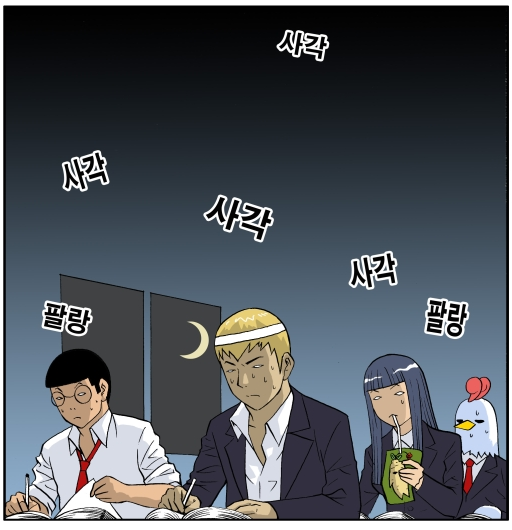
 Image source: Ipsi Myungmoon Jungle-go
Im my class of 70 students, only three graduated on time, that is, within the span of 4 years (or 8 semesters). One graduated a semester early by cramming his credits. About half of them graduated after 9 or 10 semesters.
Even weighing in the fact that Korean men serve in the military for 2 years, Koreans, both male and female seem to take at least two semesters off prior to graduation. This year, entrants from year 2010 (for women) and from 2008 (for men) should be graduating – but only 10 students from 2010 did, all of them women. At the graduation, there were 10 students who started university between 2004 and 2007. So, where are all those students? What are they doing, burrowed in somewhere, playing Starcraft and League of Legends?
You will find them at the library, at the reading rooms, at the hagwons – all cramming for some exam or another. What for? The GRE? Are they all going to grad school? No. They’re preparing to pass several exams in order to find a job at a good company. Seriously? Exams to get into companies? Yes indeed-y.
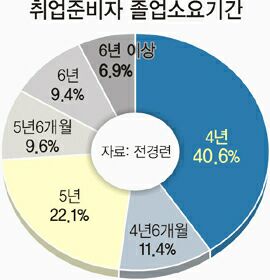
Data source: Korean Federation of Industries via Segye Daily
What kind of exams?
(1) TOEIC / TOEFL / OPIC: Some form of English language proficiency exam. Scores are mandatory to apply. You must also pass rounds of English-language interviews for most positions, so “English conversation” courses are immensely popular too.
(2) A Second foreign language – Many companies give you extra points for having attained certain levels of 2FL: Delf B2, HSK 6, DELE B2 or higher, for instance.
(3) Computer literacy – Microsoft Excel, PPT are a must. Photoshop is a plus.
(4) Each company’s “aptitude test”: consisting of various logic, arithmetic, geometry, spatial cognisance.
(5) Depending on the company, various types of national “certificates” or “licenses”: Trade Theory, Accounting (AICPA/CPA), Taxation, so on.
Take my friend Emma for example. She wants to work for a trading company – Daewoo International, LG Corp, Samsung C&T. She wants a high score on her TOEIC and TOEIC Speaking of course. Over 900 and 170, respectively. Luckily she spent a year abroad in the US as an exchange student. Otherwise she might need to take a year off and study English somewhere. She also wants to apply to work for the Latin American trading teams – so she’s taking Spanish, to pass the DELE B2. Additionally, she want to demonstrate her interest in trade, so she’s joined her university’s Marketing Club, and she will be taking the International Trade Specialist certificate exam – for which she will study Trade Law, Financing, Contracts and Trade English. Despite all this, she’s still regretting the fact that she hasn’t undertaken an internship – she didn’t qualify because her major is in English literature. Had it been Business administration or Spanish literature, they would have taken her resume more seriously. Oh, and did I mention she’s retaking three courses, because she wants to bring her GPA to over 4.0? It’s because her major is not a “serious” major, that’s why she needs good grades, at least.
But why do you need so many qualifications to work at a company? Well, Korea is a densely populated country with a highly educated population (80% of the population pursuing higher education) who are drilled into pursuing success as defined by society. Everybody wants to work at a “top company”, and well, how many “best”s can there be? Although everyone aspires for the “quiet, lesisurely” life, many believe that in order to achieve the former they must sacrifice their youth to an extent. “To burn your youth for a good life afterwards” seems to be an accepted proverb.
Several social, structural reasons can be rooted to this issue. But the biggest reason, in my opinion, is the lack of a strong social welfare system. Korea has a compulsory National Pension System (for anyone between 18 and 60 years of age) – but you must have put in money just as you would for a private insurance scheme in order to receive it in your retirement (usually at 60, but it’s possible to start receiving at 55 under special circumstances). The longer you have been paying, the more you will receive in future.
For example, if your monthly income is 1,000,000 KRW, you will have to pay 90,000 KRW monthly to the NPS. After 10 years of payment, you will be eligible to receive 166,060 KRW; after 30 years, 462,410 KRW; after 40 years, 609,210 KRW. To be able to receive about a million won in pension, you will have to have put in 300,000 every month for forty years! (Which is why Koreans trust the private insurance market)
President Park Geun-hye (yes, the dictator’s daughter, yes, really), incumbent president since 2013, introduced the “Basic Pension” scheme as a supplement to the national pension scheme, to which all senior citizens are eligible, regardless or their participation in the National Pension System. However, the maximum monthly amount receivable remains at a meager 96,800 KRW (approx. 90 USD, or 65 EUR) per person, and at 154,900 KRW (approx. 144 USD, or 105 EUR) for married couples over 65 years of age, respectively.
Considering the fact that the 2013 “minimum cost of living” (which makes you eligible for government aid) is set at 572,168 KRW (approx. 535 USD, or 392 EUR) for a single-person household, and at 974,231 (approx. 911 USD, or 667 EUR) for a two-person household, this amount is just pocket money – it won’t even cover the rent on government housing.
Because of this weak national pension, most Koreans believe it is “up to them to fend for themselves and ensure a good retirement”. The NPS’s strength, is, of course, that everybody works hard, instead of laying back and collecting pension (“moral hazard”), without a worry about what to do when they fall gravely ill. But on the down side, it deprives people of a sense of security, always.
The Park government is aware of this, and as a president whose policies have largely focused on welfare, is making progress. In 2014, the “4 Major Illnesses Aid Program” was beta-launched. When it is finalised, the Program will reduce medical fees for cancer, cardiovascular, cerebrovascular, and rare diseases. As a contrast with the previous Lee government, who cut heavily on public spending but focused on macroeconomic growth, Park’s regime seems to be “modernising”. The transition team from Lee to Park included Professor Ahn Sang-hoon, who studied social welfare at Stockholm and Uppsala, something I found remarkable as a contrast to the US and UK-educated members that make up the usual bunch.


Let me know what you think :)