Author: Emily Singh

Law School Reforms: Oh-oh, Here Comes Trouble!

Public prosecutors, including the first batch of Law School graduates, are sworn into office, 2012 Image source: Joongang Daily The year I entered university (2009) was a remarkable year. It was the  first year Law Schools as 3-year postgraduate programs were introduced (same for Medical Science, but this topic really deserves another post). The goal was to “offer law (and medical) studies to a wider array of students, instead of discouraging them at the high-school level”. As a result, the Gosi System (사법고시, or ‘National Bar Exam’, but I will use the term ‘Gosi’ in order to distinguish it from the National Bar the current Law School graduates have to pass) will end in 2017. Instead, Law School graduates will have to pass the National Bar, a much simpler exam, in order to start practicing. A difference is that one does not need to hold a LLB or LLM in order to pass the Gosi, but one does need an LLM to become a lawyer with the new Law School system. In reality, prior to this, …

How Koreans Who Are Merely Acquaintaces Quarrel

[Image description: A square is split into two parts, a blue part and a red part. Both have a black circle at the centre. In the blue square, a line of white footsteps walks right through the centre of the black circle, on to the other side of the square. In the red square, a line of white footsteps is seen carefully treading around the circle while making its way to the other side.  Image source: Laurent Haug] In a nutshell: by text-message, in politely arranged words, and over weeks, without every calling each other rude names and making sure they do not offend the other person. I recently had a ‘quarrel’ with a Korean acquaintance whom I worked with two years ago. We keep in touch a couple of times a year by text, but have never met since. Let’s call this friend A. A asked me to translate a couple of documents for him. I said yes, and obviously I thought I was going to be paid, since he knows I work as …

Seoul And Its “Tourists”

“Madame Butterfly” (Image source: Movieposter.com) I have very little respect for Puccini, simply because of this opera.   My friend once met a marijuana-selling Frenchman in Seoul who said: I want to stay here forever. In France I would never, ever get laid, but here, girls are hitting on me just because I am French. Being a foreigner means many things in Korea. You’re “different”. This “being foreign” status entitles you to many advantages as well as prejudices. For instance, it you are a Caucasian-looking woman, men will assume you are readily available for sex. But on the other hand, if you are a Caucasian-looking man, your mother-in-law-to-be won’t grill you with “What do your parents do? “Where is your hometown?” “Do you own an apartment in your name?” “How much do you make?”, like she would a Korean son-in-law-to-be. Korea attracts a very wide array of migrants. There are the English teachers. The businesspeople. The Korean Studies students. Or, those passing by, on exchange student programs, on a Korean government (NIIED) scholarship, on an …

A petty moral dilemma: SSAT, HKAT, and LG Fit walk into a bar…

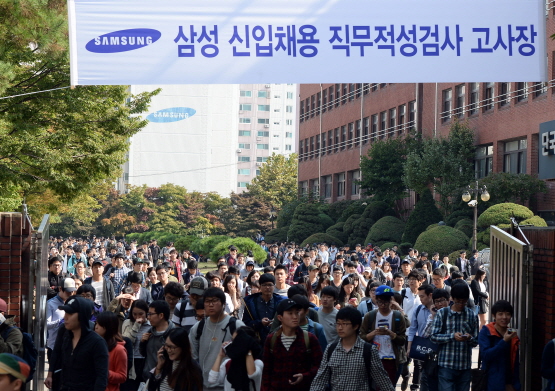
“Samsung Aptitude Test Center for New Recruits” Image source: Etoday News Yes, you read that right. A Moral Dilemma. And no, I’m not talking about political choice or anything fancy like that. Last year, approximately 100,000 graduates applied to take the SSAT, Samsung Aptitude Test. What? There’s a standardized exam to work for a private company? Just for a managerial job? And they rent entire school buildings for it? And people pay up to 200,000 KRW (approx. 200$ for online crash courses? And universities bring in private tutors and provide weeks or months-long courses to prep graduates? Well, actually, this may not have the shock value I was hoping for, since you already know I’m writing about South Korea. But anyway. Despite the booming economy in East Asia (as compared to the US and Western Europe anyway), it’s becoming tougher and tougher to find a job in South Korea, especially if you’re leaving university with only a Bachelor’s degree. What? Isn’t that what BA graduates do, go work in companies, just precisely because they didn’t want …

Korean Dictionary Reverts to Homophobic State

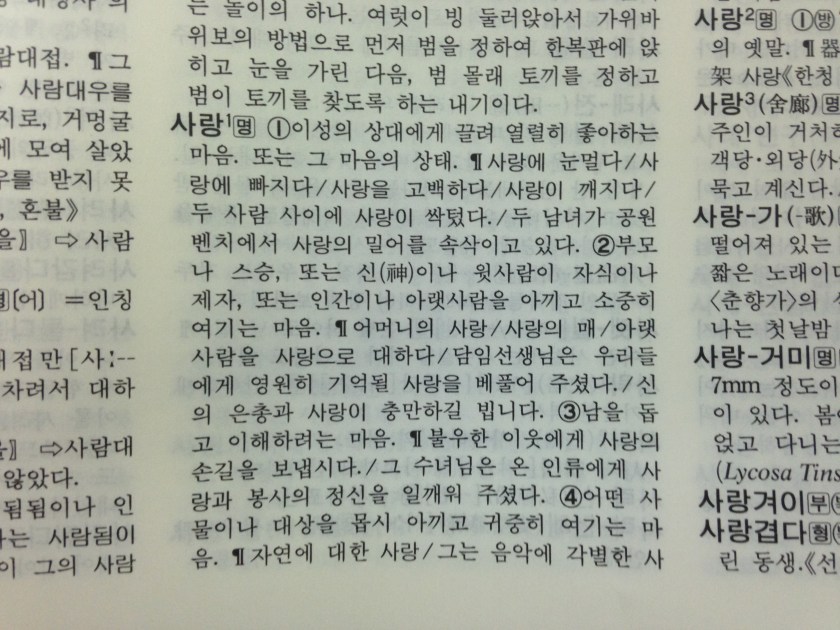
The 1999 Edition of Standard Korean Unabridged Dictionary, published by NIKL Photo by me In November 2012, the Standard Korean Unabridged Dictionary, published by the National Institute of Korean Language (NIKL), re-defined five words: 사랑 (love) 애정 (love, affection) 연애 (dating, courtship) 연인 (‘partner’, without referring to specific gender) 애인 (‘lover’, without referring to specific gender) All five words were changed to gender-neutral definitions. For instance, ‘love’ was re-defined from a feeling of attraction towards a member of the opposite sex to a feeling of attraction between two people. Likewise, lover was redefined as two people who are attracted to each other, as opposed to a female and male person who are attracted to each other. Many members of the LGBT community rejoiced at this small change, which would allow them to talk about themselves and their feelings free from heterosexuality-based words. However, barely a year later, in January 2014, Christian advocacy groups (technically, Protestant) lobbied into reverting these newly defined words to their original state. Such religious advocacy groups have been backing anti-LGBT movements in many different forms – When dramas with LGBT characters are televised, they place …

Why do Koreans graduate so late from uni?

Image source: Ipsi Myungmoon Jungle-go Im my class of 70 students, only three graduated on time, that is, within the span of 4 years (or 8 semesters). One graduated a semester early by cramming his credits. About half of them graduated after 9 or 10 semesters. Even weighing in the fact that Korean men serve in the military for 2 years, Koreans, both male and female seem to take at least two semesters off prior to graduation. This year, entrants from year 2010 (for women) and from 2008 (for men) should be graduating – but only 10 students from 2010 did, all of them women. At the graduation, there were 10 students who started university between 2004 and 2007. So, where are all those students? What are they doing, burrowed in somewhere, playing Starcraft and League of Legends? You will find them at the library, at the reading rooms, at the hagwons – all cramming for some exam or another. What for? The GRE? Are they all going to grad school? No. They’re preparing to pass several …

LGBT Poster vandalized on university campus…yet again!

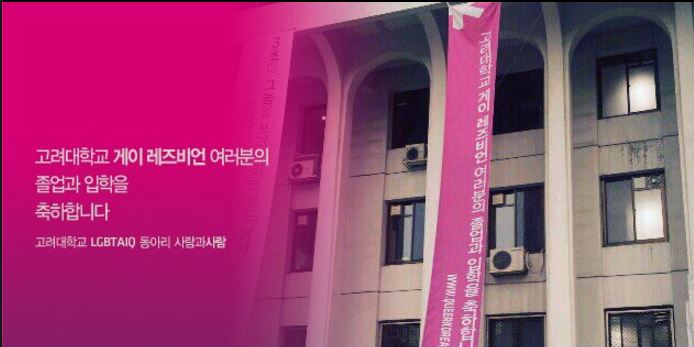
Korean LGBT folk have it pretty bad. In fact, they’re not too surprised to be targeted, teased, or discriminated. It’s just the way things have been, and continue to be. A gay friend told me that back in the early 2000s when he was in university, LGBT societies would get student Christian groups gather in front of their club room, sprinkle holy water on their door, and sing gospel songs “in order to save those poor souls being led astray by Satan”. This doesn’t happen anymore, maybe due to the fact that since then, LGBT societies would be given “anonymous” club rooms on campuses, disguising their namecards on the door or by merging many of their activities with the women’s rights groups. But university LGBT societies have constantly been unable to even welcome newly admitted students, like many other societies and clubs do – mostly because some crazy individuals acting in the name of the Christian religion keep vandalising their posters and placards. Although this is not the first time such an event has occurred, this …

My Swedish friends discuss the English word “bitch”

  “hen”: Swedish gender-neutral third person pronoun My friends Mow, Gee, Lanka, Eva and Bohr and I were having a little gathering at my place. The Swedes would call it a förfest (pre-party). Now, Gee is a Turkish graduate student from Lund, in Korea for one term to study the Saemaeul movement, as well as make some money working for Samsung (duh!). As we were in the company of Swedes, he teased them about the sing-along drinking games the merry tall folk play. Then it began. Swedish social drinkers Mow, Eva, and Bohr suggested we play this game, in which we would call the “it” person “bitch”. The trio began to hesitate in Swedish. The talk was hushed, but intense, and serious. Lanka, Gee, and I asked. What’s going on? Is the game too complicated to explain? No. It was that we had to call the person “bitch”. What did they mean? The word “bitch” apparently has a more gender-neutral equivalent in Swedish, while keeping the sassy tone. “What about man-bitch then?” “No, because that puts the …

My Non-Valedictorian Speech That Was Never Caught on Camera

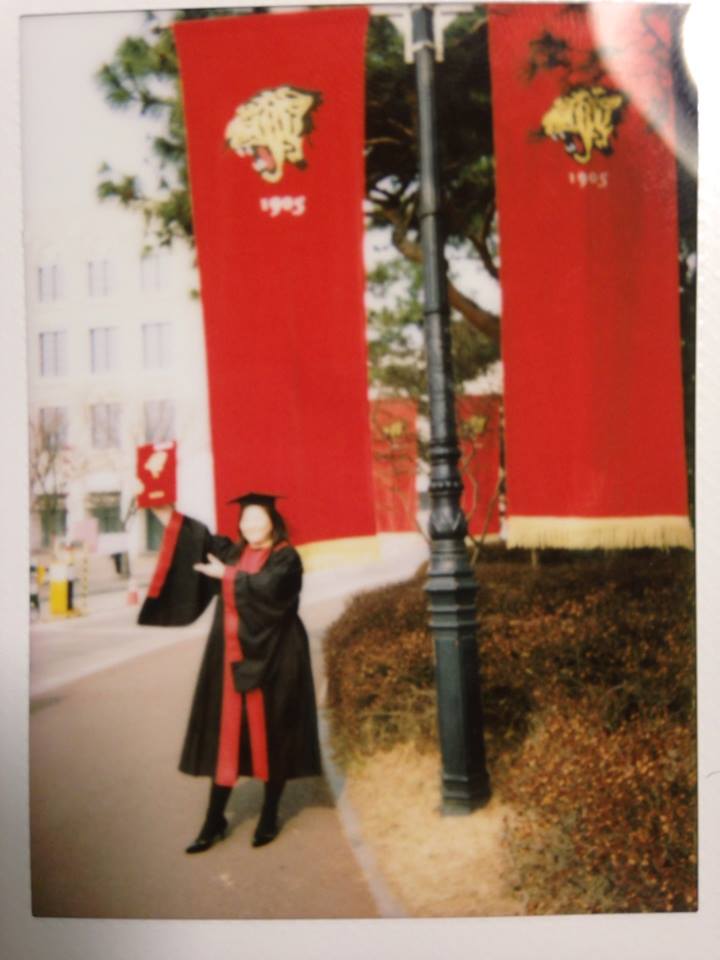
Me looking all grown-up and holding my $40,000 degree (no taxes!) Photo source: Un-graduating friend working as my assistant du jour Hello Citizens of the Internet! I graduated today, and since I was not one of those fancy valedictorian-summa cum laude people, I decided to write a little dedication to the wonderful people I met during my five years at university. There’s a little part dedicated to the horrible people too, but feel free to skip over that. Good vibes only amirite? TO THE HUMAN BEINGS: Dear Professors who wrote me recommendation letters for graduate school: Thank you. Because I wasn’t an excellent student and you had no reason to write them. From one of you, I took two development courses in which I got As, which was great. But from another of you, I’d only gotten Bs in history, and I kind of know that you didn’t really know who I was until I turned up at your office asking for a recommendation. But I know you were too gracious to say “Oh, you’re that …

Do (South) Koreans Really Want Reunification?

Photo source: Yonhap News (Feb 22nd, 2014) Short answer: No. To be precise, it’s “Don’t really care“, not “Don’t want”. Reunification doesn’t carry the note of passion it used to in my parent’s generation – back then, if you were asked “Do you want tongil?”, and you said no, you were a complete treacherous, unpatriotic, heartless brat. But now, we’re too busy thinking about other things, the memories of having once been a single nation are fading, and most of all, Koreans most definitely do not want to carry the economic burden reunification will entail. Despite the avid propaganda from the South Korean government – Reunification will allow us to tap into the North’s invaluable mineral resources, we will gain direct access to cheap and disciplined (disciplined, for lack of a better word…) labour force, we are of the same blood and are one people – People’s enthusiasm has grown thin with the crazy outbursts of “We will see Seoul burst in flames if you don’t give us what we want and respect us” tantrum …